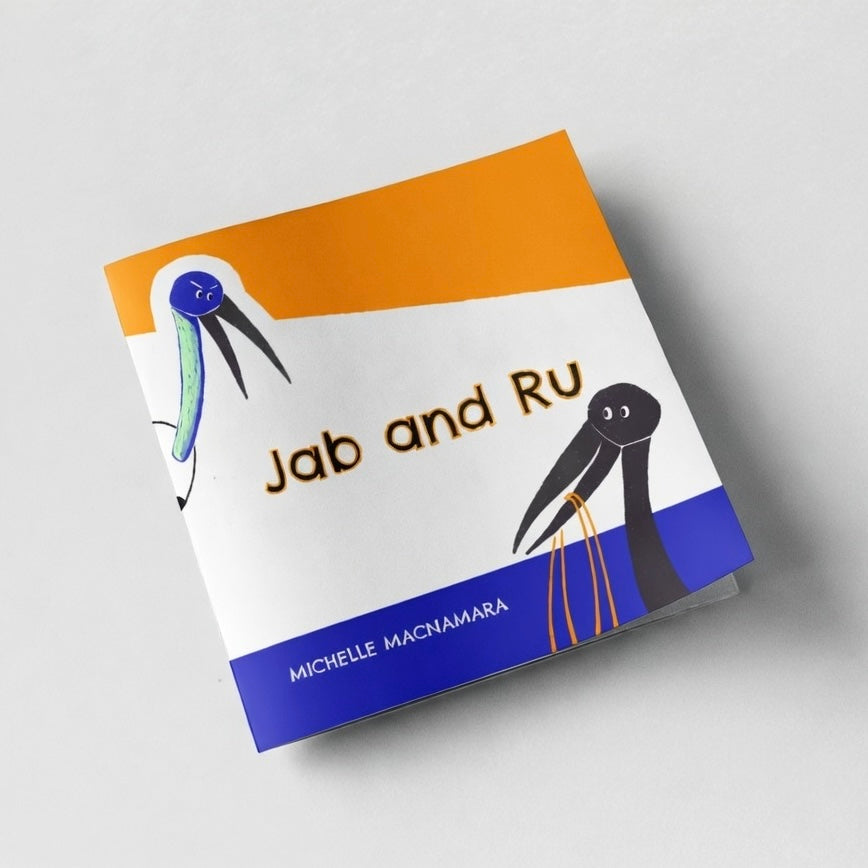
The Story Of An Unlikely Friendship.
Ru is a proud Australian black-necked stork who loves his fishing spot and doesn’t like to share. Far away in the Americas lives Jab, a friendly young jabiru stork who’s always ready for an adventure.
When a silly mail mix-up brings Jab all the way to Ru’s swamp, these two tall white storks; who look like cousins but live on opposite sides of the world… discover how sharing and kindness can turn strangers into friends.
Told in lively rhyme, and featuring 14 Fun Facts about real jabirus for curious kids, Jab and Ru is a delightful story that teaches the simple joys of opening your world to others.
Target Age: 3-8
14 Fun Facts About Jabirus
Australian Jabiru (Black-Necked Stork)
1. It is Australia’s only stork and one of its biggest wading birds. It stands 1.3 metres tall with wings over 2 metres wide!
2. It has a snowy white body, shiny green-purple neck (looks black from far away), long black beak, and bright red legs.
3. It's easy to tell boys from girls: males have dark brown eyes, females have bright yellow eyes!
4. It lives in swamps, rivers and floodplains in northern and eastern Australia, as well as Asia and New Guinea.
5. It is a super hunter! It jabs its beak into shallow water to catch fish, frogs, crabs and even baby turtles.
6. Bossy and mostly alone. It guards its favourite fishing spots with loud grunts and bill claps!
7. It can live up to 30 years and stays with the same mate for life.
American Jabiru (Jabiru Mycteria - The “real” Jabiru)
1. It is the tallest flying bird in Central and South America. Up to 1.5 metres tall with wings nearly 3 metres wide!
2. Its bright white body with a bald black head and neck plus a stretchy red pouch. Its name means “swollen neck”!
3. It has a huge black beak that’s perfect for grabbing slippery food!
4. It is found near wetlands, rivers and lakes from Mexico down to Argentina… especially in Brazil’s giant Pantanal swamps.
5. It eats fish, frogs, snails, snakes and even small mammals.
6. It is friendlier than its Aussie cousin! Often hangs out in small groups and builds huge stick nests (up to 2 metres wide) high in tall trees.
7. It is a gentle giant that fiercely protects its babies.